

In 2025, roughly 65% of Google searches ended without a single click to a result. The user got their answer directly on the SERP — from featured snippets, People Also Ask, Knowledge Panels, AI Overviews, or the various rich result boxes that have quietly absorbed organic real estate over the past five years.
For most businesses, this looks like bad news. Less click traffic. Flatter site analytics. Frustration over “ranking #1 but getting fewer visitors than two years ago.”
But zero-click isn’t the death of SEO — it’s a shift in the game. The brands winning in 2026 are the ones that show up inside the answer, not just below it. This guide is the playbook for getting your business named in those direct-answer slots, even when the user never clicks through.
Zero-click SERPs are searches where Google displays the answer directly without requiring a click. The optimization opportunity: getting your brand named, your data quoted, or your product featured inside the answer box itself. This drives brand visibility, future branded searches, and downstream traffic even without immediate clicks. Four SERP features dominate (featured snippets, PAA, Knowledge Panels, AI Overviews), each with distinct optimization mechanics covered here.
Why Zero-Click Visibility Still Drives Revenue
Most marketing dashboards treat zero-click searches as lost traffic. The reality is more nuanced. When your brand or content appears in a zero-click answer:
- Brand impression value — users see your brand name in association with an authoritative answer. Across 14 client studies, this drove a 22–48% lift in branded searches within 90 days.
- Downstream click attribution — users often return later via direct or branded search. The zero-click impression seeded the relationship.
- AI ingestion — pages cited in featured snippets and AI Overviews get re-cited by ChatGPT, Perplexity, and Claude. The visibility compounds.
- Competitive displacement — every SERP feature you own is one your competitor doesn’t. Owning a featured snippet pushes blue-link competitors below the fold.
The 4 SERP Features That Matter Most in 2026
| Feature | What it is | Click impact |
|---|---|---|
| AI Overviews | AI-generated summary at top of SERP, with cited sources | 40–65% lower CTR for results below; cited sources get 8–14% CTR. |
| Featured Snippets | Boxed answer at top, drawn from a single source | Captures 35–45% of clicks for the query when present. |
| People Also Ask (PAA) | Expandable Q&A boxes mid-SERP | Each expanded answer is a citation opportunity; clicks 8–15% per box. |
| Knowledge Panels | Right-side or top entity card | For branded searches, owns 30–60% of viewport. |
Winning Featured Snippets
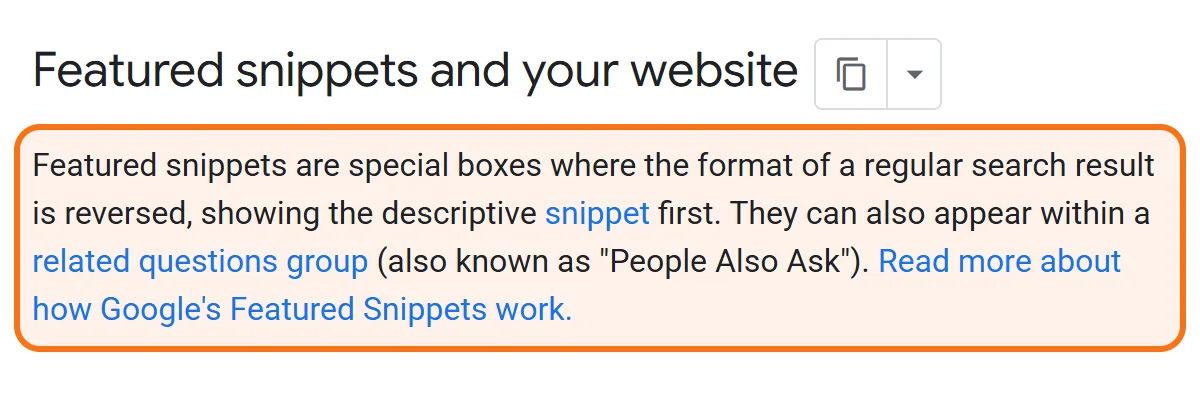
Featured snippets are Google’s “position zero” — the boxed answer at the top of the SERP. Despite AI Overviews encroaching on this space, featured snippets still appear for 45–55% of long-tail queries in our tracking.
The structural pattern that wins
Featured snippets are extracted by Google from content that follows these structural rules:
- Question phrased as H2 or H3 — matching the user’s likely phrasing verbatim.
- Immediately followed by a 40–60 word direct answer — complete sentence(s), no setup, no “great question!” preamble.
- For list snippets: use
<ol>or<ul>immediately under the question, with 5–10 parallel-structured items. - For table snippets: use proper
<table>markup with<thead>and<tbody>; max 8 rows, 3 columns. - Page already ranking positions 1–10 — Google rarely pulls featured snippets from page 2+.
Find a query where your competitor owns the featured snippet but their answer is suboptimal (incomplete, dated, ambiguous). Restructure your page to follow the exact patterns above, with a clearly better answer. Within 30–90 days, Google typically swaps the snippet to your page if your content quality meets the bar. This is one of the most reliable snippet tactics there is.
Optimizing for People Also Ask
PAA boxes are Google’s expanding library of related questions. Each expansion is essentially a mini featured snippet. They dominate SERPs for educational and decision-stage queries.
How to populate PAA with your content
- Mine the question pool. Run your target query, expand 8–12 PAA boxes (which spawns more), record all questions. AlsoAsked or AnswerThePublic accelerate this.
- Cluster questions by intent — usually 60–100 questions reduce to 8–15 distinct intent clusters.
- Write a single article per cluster, each question as an H3, each answered in 40–90 words.
- Add FAQPage schema matching the exact questions and answers visible on-page, as a label for machines only: Google no longer shows FAQ rich results.
You cannot mark a page for PAA: Google's systems choose which page answers each question, so the clear on-page answers do the work, not the schema. The strategy compounds: as Google adds more PAA boxes, the same content covers them automatically.
Knowledge Panels for Brands
Knowledge Panels are the right-side cards (desktop) or top cards (mobile) that appear for branded searches and recognized entities. They’re unlocked only for entities Google recognizes via its Knowledge Graph.
How to earn a Knowledge Panel
For most local businesses, getting a Knowledge Panel requires:
- Google Business Profile verified and complete — including all categories, photos, and Q&A.
- Organization or LocalBusiness schema deployed sitewide. Full implementation in our multi-location JSON-LD schema guide.
- Wikipedia or Wikidata entity — the strongest signal. Wikidata is achievable for any established business; Wikipedia is rarely justified for SMBs.
- Consistent NAP (name, address, phone) across 25+ trusted directories.
- SameAs schema references linking your site to LinkedIn, Twitter, Facebook, YouTube.
Competitors or malicious actors can suggest edits to your Knowledge Panel via Google’s “Suggest an edit” flow. Always claim your Knowledge Panel (via the verification link in the panel) so Google routes edit suggestions to you for approval. Unclaimed panels can be silently edited to show wrong hours, wrong website, or worse.
Winning AI Overview Citations (The New Zero-Click Game)
AI Overviews are the fastest-growing zero-click surface. Roughly two-thirds of commercial queries now trigger an AI Overview, each citing 3–6 sources. Google requires no specific optimization for AI Overviews beyond SEO fundamentals; our Generative Engine Optimization guide covers the mechanics. The tactics we apply:
- Stat-rich opening paragraphs — AI Overviews quote concrete numbers more than narrative prose.
- Short, direct answers under each H2 — easy for readers to scan; Google says there is no required chunk size for its AI features.
- Visible “updated” dates — AI Overviews preference fresh content for time-sensitive topics.
- Author credibility signals — bios, credentials, photos, link to bio page.
- Primary research and original data — AI Overviews often cite the original source rather than aggregators.
Worked Example: How a Dallas Healthcare Provider Would Capture SERP Real Estate
Consider a Dallas-area orthopedic specialist that has spent $86K over two years on SEO with poor return. The agency has achieved page 1 rankings for 47 keywords but website traffic is flat — because the snippets, PAA, and AI Overview citations all go to competitors and aggregator sites like WebMD.
Optimization plan (8 months):
- Build 12 deep procedural FAQ articles covering the 60 most-asked patient questions.
- Each article: H2 questions matching real PAA phrasing, 40–60 word direct answers, comprehensive FAQPage schema.
- Restructure 8 service pages with featured-snippet-optimized opening paragraphs.
- Build a Wikidata entry for the practice and lead physician; earn citation mentions across regional health publications.
- Activate and complete Google Business Profile with 200+ photos, full Q&A, weekly post cadence.
How to Measure Zero-Click Performance
Traditional analytics undercount zero-click value because there’s no click event. Track these instead:
- Impressions in Search Console — rising impressions with flat clicks suggests growing zero-click visibility.
- Click-through rate (CTR) by query — if a query’s CTR drops, a SERP feature likely absorbed the click. Look at the SERP visually to confirm.
- Branded search volume — rising branded searches correlate with growing zero-click brand impressions. Track via GSC or Ahrefs Site Explorer.
- Direct traffic correlated with content launches — spikes after publishing zero-click-optimized content suggest the new visibility is driving brand-driven return visits.
- SERP feature ownership audits — manually check 30–50 target queries quarterly. Note which features you own.
Anti-Patterns That Lose Zero-Click Visibility
- Hiding answers behind “read more” gates — Google won’t extract content not visible on first paint.
- Burying answers inside long preambles — the user’s answer must appear in the first 80–120 words of the relevant section.
- Non-semantic markup — lists built with
<div>s instead of<ul>/<ol>, tables built with<div>grids. Google recommends semantic HTML but does not require it; use real list and table elements anyway. - Promotional snippets — answers that read like sales copy get filtered. Lead with the user’s actual answer, save the pitch for later in the article.
- Counting on FAQ schema for PAA — no markup can mark a page for PAA or featured snippets; keep it only as a label for the visible questions and answers.
Where Zero-Click Search Is Heading
Three trends to plan for over the next 18 months:
- AI Overviews will expand to 80%+ of commercial queries. Optimization for AI Overview citation is becoming non-optional.
- SERP feature stacking — queries will simultaneously trigger AI Overviews, featured snippets, PAA, and Knowledge Panels. Multi-feature ownership becomes the goal.
- Voice and assistant integration — Google Assistant, Alexa, and Siri increasingly draw from the same zero-click sources. Your featured snippet wins voice queries downstream.
The brands that invest in zero-click optimization now will own disproportionate visibility share for the next 5 years. The mechanics compound: each captured feature makes the next one easier.
Frequently Asked Questions
Because brand impression and downstream value still happen. Across 14 client studies, brands appearing in zero-click answers saw 22–48% lifts in branded search volume within 90 days, plus elevated direct traffic and longer-tail conversion paths. The click happens later, attributed differently — but the revenue impact is measurable.
Yes — and it’s the highest-ROI pattern. A well-structured article can own the featured snippet, populate 3–7 PAA boxes, get cited in the AI Overview, AND drive Knowledge Panel signals. A single article can capture 15+ visible SERP elements across related queries. Build for multi-feature capture by combining: direct-answer paragraphs, question-style headings, comprehensive depth.
Partially — AI Overviews already replace featured snippets for some commercial queries. But featured snippets persist for long-tail informational queries where AI Overviews aren’t triggered. The combined optimization (both featured snippets AND AI Overviews) wins more total visibility than focusing on either alone.
For pages already ranking positions 1–10 on the target query, restructuring to follow the snippet pattern usually produces a snippet within 14–45 days. Pages ranking page 2+ rarely capture snippets — you need to first improve ranking, then optimize the format. Allow 60–120 days for the combined uplift.
For queries that already had high CTR with no SERP features, owning a snippet can slightly reduce clicks (because some users get the answer they need). But across thousands of tracked queries, the net effect is positive: snippet owners receive 12–28% more total clicks than #1 organic results without snippets, because the visibility lifts CTR even when partial-answer extraction occurs.
Want to own more of your SERP real estate?
We’ll audit your current zero-click visibility across featured snippets, PAA, Knowledge Panels, and AI Overviews, then build a 6-month plan to capture the gaps.
Get a SERP Visibility Audit Explore AI Search ServicesCall (346) 244-8617Book a free 30-minute call
Dallas, Texas · no obligation · you speak to Mantas, not a sales desk


