

Smart Bidding is Google’s most powerful Google Ads feature — when configured correctly with the right strategy for your business model. Most Dallas businesses use the wrong Smart Bidding strategy because Google’s account representatives recommend whatever maximizes Google’s revenue (typically Maximize Conversions), not whatever maximizes the advertiser’s profit. The choice between Target CPA and Target ROAS isn’t arbitrary — it’s determined by your profit margin structure, your conversion value variance, and your data infrastructure.
From deploying Smart Bidding strategies across Dallas Google Ads accounts, here is the clear decision framework. Target CPA works best for businesses with consistent profit margins and similar conversion values across clients. Target ROAS works best for businesses with significant variance in client value and the data infrastructure to feed accurate value signals to Google’s algorithm. The wrong choice produces 20-60% worse profit outcomes despite hitting the wrong metric targets perfectly.
Target CPA optimizes for consistent cost per conversion — correct for businesses with uniform client values (most service businesses, simple e-commerce). Target ROAS optimizes for revenue return per ad dollar — correct for businesses with variable client values and proper conversion value tracking (B2B SaaS, premium services, complex e-commerce). The wrong choice produces 20-60% worse profit outcomes. Most Dallas businesses should start with Target CPA and graduate to Target ROAS only after building proper value tracking infrastructure.
Looking for hands-on help instead of DIY? Skip ahead to our Smart Bidding strategy optimization.
The Smart Bidding Strategy Fundamentals
Target CPA Explained
Target CPA (Cost Per Acquisition) tells Google: “Get me as many conversions as possible at an average cost of $X per conversion.” Google’s algorithm optimizes bid timing, audience targeting, and placement decisions to deliver conversions at your specified target cost.
How Target CPA Works
You set a target cost (e.g., $150 per conversion). Google’s algorithm bids dynamically in each auction — sometimes higher than $150 (for high-conversion-probability clicks), sometimes lower — with the goal of averaging out to your target. Over time, the algorithm learns which signals predict conversions and concentrates spend on high-probability scenarios.
When Target CPA Is Correct
- Consistent profit margins across most conversions (every client worth roughly the same)
- Similar deal sizes — no significant variance between small and large conversions
- Limited conversion value data — can’t reliably feed transaction values to Google
- Service businesses with relatively standardized offerings
- Lead generation where actual client value is measured downstream
Target ROAS Explained
Target ROAS (Return on Ad Spend) tells Google: “Get me as much revenue as possible at an average return of $X per $1 of ad spend.” Google’s algorithm optimizes for high-value conversions specifically, willing to spend more per click when the predicted conversion value justifies it.
How Target ROAS Works
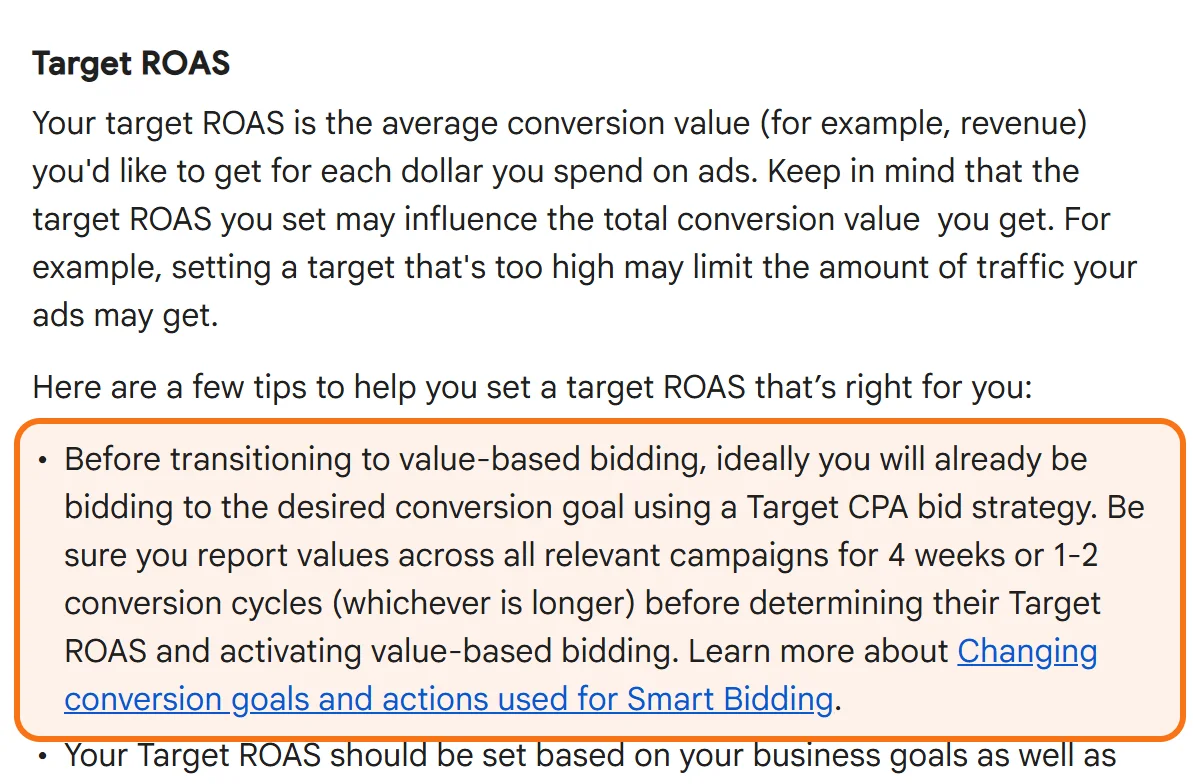
You set a target return (e.g., 400% ROAS = $4 revenue for every $1 ad spend). Each conversion in Google Ads carries a conversion value. Google’s algorithm uses conversion value prediction to bid — high-value-predicted clicks get aggressive bids, low-value-predicted clicks get conservative bids or skipped.
When Target ROAS Is Correct
- Significant variance in client values (deal sizes from $500 to $50,000)
- E-commerce with diverse product price points
- B2B SaaS with annual contract value variations
- Premium services where client LTV varies dramatically
- Strong conversion value tracking infrastructure feeding real numbers to Google
The Profit Margin Math That Determines Your Choice
Consistent Margin Businesses → Target CPA
If your gross margin is roughly the same on every client, Target CPA works because:
- Every conversion produces approximately equal profit
- Cost-per-conversion directly correlates to profit-per-conversion
- Optimizing for low CPA = optimizing for high profit
Examples
- Dallas dental practice with relatively standardized procedures
- HVAC service business with consistent residential service tickets
- Tax preparation service with standard fees by return complexity
- Legal services with consistent retainer structures
Variable Margin Businesses → Target ROAS
If gross margin varies significantly by client, Target CPA misleads because:
- A $50 CPA for a $5,000 client is highly profitable
- A $50 CPA for a $200 client is unprofitable
- Cost-per-conversion alone doesn’t reflect profitability
- Target CPA may direct spend toward easy-to-acquire low-value clients
Examples
- Dallas B2B SaaS with $99/month and $5,000/month tiers
- E-commerce with $20 accessories and $2,500 main products
- Commercial real estate brokerage with $5K and $500K commissions
- Consulting firm with $2K projects and $200K engagements
Data Infrastructure Requirements
Target CPA Data Requirements (Lower)
- Reliable conversion tracking firing on meaningful business actions
- Enough volume to judge results: Google recommends evaluating over periods with at least 30 conversions (we prefer 50+ per month)
- Consistent conversion definitions across the account
- 15-30 day attribution window matching your sales cycle
Target ROAS Data Requirements (Higher)
- Everything Target CPA requires, plus:
- Accurate conversion value data for every conversion
- Conversion values reflecting actual revenue (not arbitrary estimates)
- At least 15 conversions with values in the past 30 days to be eligible on Search (Google's minimum); we prefer 50+ per month
- Variance in conversion values (if every value is similar, ROAS = CPA effectively)
- CRM integration for closed-deal value attribution (essential for B2B with long cycles)
Hybrid and Advanced Strategies
Conversion Value Rules (Target CPA → Target ROAS Hybrid)
Google Ads added Conversion Value Rules in 2022 that allow Target CPA-like simplicity while introducing some value differentiation. Set base conversion value, then adjust upward or downward based on:
- Geographic location: Dallas commercial geographies +50%
- Device: Desktop +20% (typical for B2B)
- Audience: Customer Match Enterprise audience +200%
- Time of day: Business hours +25% (typical for B2B)
This provides Target ROAS-like differentiation without requiring full value tracking infrastructure. Excellent intermediate strategy for Dallas businesses transitioning from simple to sophisticated Smart Bidding.
Portfolio Bid Strategies
For accounts with multiple campaigns sharing similar goals, portfolio strategies allow consistent Target CPA or Target ROAS across the campaign group while allowing budget to flow to highest-performing campaigns. Useful for managing multiple service lines or geographic areas under unified business goals.
Maximize Conversion Value (No Target)
For accounts with strong conversion value data but unable to set a specific ROAS target (e.g., new campaigns without ROAS benchmarks), Maximize Conversion Value lets Google optimize for revenue without constraining to a target. Useful for discovery phase before establishing target ROAS.
5 Common Smart Bidding Mistakes
Mistake 1: Setting Target Too Aggressive
Setting Target CPA 30% below historical average or Target ROAS 30% above historical average triggers Google’s algorithm to dramatically reduce impressions trying to hit unrealistic targets. Result: traffic and conversions collapse. Set targets within 10-15% of historical performance during initial optimization.
Mistake 2: Changing Targets Too Frequently
Smart Bidding requires 14-30 days of stable signals to learn. Changing Target CPA every week prevents learning and produces erratic performance. Set the target, leave it for 14+ days minimum, evaluate performance against the target, then adjust if needed.
Mistake 3: Using Smart Bidding Without Sufficient Conversion Volume
Google says Target CPA can start with no conversion history, but it recommends judging results only over periods with at least 30 conversions (50 for Target ROAS). In accounts far below that volume we usually stay on manual bidding until conversions build, because there is too little data to tell whether the strategy is working.
Mistake 4: Mixing Conversion Goals
If your conversion tracking includes both form fills ($50 value) and closed deals ($5,000 value) in the same conversion action, Smart Bidding becomes confused. Separate primary conversions (revenue-producing) from secondary conversions (engagement indicators). Use only primary conversions for bid optimization.
Mistake 5: Not Feeding Conversion Values to Smart Bidding
For Target ROAS to work, every conversion must have a meaningful value attached. Many Dallas accounts use Target ROAS while sending Google flat $1 values on every conversion — making Target ROAS function identically to Target CPA but with worse outcomes. Send real values from your CRM (covered in our CRM Smart Bidding article).
| Mistake | Why it hurts | Do this instead |
|---|---|---|
| Target set far beyond what the account has achieved so far | Google cuts impressions trying to hit it, so traffic and conversions collapse | Start with a target close to your historical performance |
| Changing the target every week | The bidding system never finishes learning and results turn erratic | Leave the target alone for at least 14 days before you judge it |
| Form fills and closed deals counted in one conversion action | The bidding system cannot tell a cheap lead from real revenue | Bid only on primary, revenue-producing conversions; keep the rest secondary |
| Target ROAS with the same flat value on every conversion | It then works like Target CPA, with worse outcomes | Send a real value from your CRM with each conversion |
Each of these is a setup problem you control: the target you set or the conversion data you send. Fix them before you switch strategies.
- Target CPA Explained
- Target ROAS Explained
- Consistent Margin Businesses → Target CPA
- Variable Margin Businesses → Target ROAS
Dallas Google Ads accounts split clearly along service-business vs e-commerce/SaaS lines for Smart Bidding strategy choice. Dallas service businesses (legal, healthcare, home services, professional services) typically have consistent margins and benefit from Target CPA. Variability in deal size exists but the marketing optimization payoff from Target ROAS rarely justifies the data infrastructure complexity for businesses with relatively standardized service offerings.
Dallas e-commerce and B2B SaaS accounts in the Plano-Las Colinas tech corridor benefit dramatically from Target ROAS when properly configured. The Telecom Corridor B2B SaaS ecosystem typically features 5-15x variance in annual contract value across client types (small business vs mid-market vs enterprise) — making Target CPA actively harmful because it directs spend toward easy-to-close low-value clients. Target ROAS with proper CRM-fed conversion values directs spend toward high-value prospects matching the ICP.
For Dallas businesses in transition (service businesses adding premium tiers, or B2B SaaS launching new product lines), Conversion Value Rules provide an intermediate strategy worth considering. Conversion Value Rules deploy in 2-4 hours of work, require no CRM integration changes, and provide most of the Target ROAS benefits without the data infrastructure investment. We typically recommend Conversion Value Rules as the bridge strategy for Dallas businesses graduating from Target CPA toward full Target ROAS over 3-6 months.
Worked Example: Target CPA vs. Target ROAS on a Tiered SaaS
Consider a Plano-based B2B SaaS company selling project management software with three pricing tiers: Starter ($99/mo), Professional ($499/mo), Enterprise ($2,400/mo). It spends $14,200/month on Google Ads with a Target CPA strategy set at $80 per signup. The CPA target is hit consistently — about 178 signups per month at $79.78 average CPA. But monthly recurring revenue from Ads is stuck at $87K despite consistent signup volume growth.
The diagnostic: Target CPA optimizes for the easiest signups to acquire, which skews heavily toward the Starter tier ($99/mo). Of 178 monthly signups: 142 Starter, 28 Professional, 8 Enterprise. The algorithm has learned that Starter signups are cheap and plentiful, and concentrates spend there — ignoring expensive but vastly more valuable Enterprise prospects.
Here is how to restructure the Smart Bidding strategy over 6 weeks. Phase 1: deploy proper conversion value tracking. Starter signup → $1,188 value (12 months Starter price). Professional signup → $5,988 value. Enterprise signup → $28,800 value. Phase 2: connect the CRM via Enhanced Conversions for Leads so actual upgrade and churn data feeds back to Google. Phase 3: switch bidding from Target CPA $80 to Target ROAS 600% (meaning $6 revenue for every $1 ad spend — matching the unit economics target). Phase 4: apply Conversion Value Rules: enterprise audience match +100%, business-hours conversions +25%, Plano-Frisco geographies +30%.
What the math looks like at 90 days: total signup volume drops from 178 to 94 (-47%) — intentionally. Starter signups fall, Professional signups grow, Enterprise signups multiply. If the mix shifts the way the value signals point, monthly MRR from Google Ads can move from $87K to $184K (+111%). Same ad budget, 2.1x revenue. In a scenario like this, the wrong Smart Bidding strategy is costing roughly $97K a month in foregone revenue.
Frequently Asked Questions
Yes, but expect a 14-30 day re-learning period each time. Each Smart Bidding strategy requires the algorithm to learn signal patterns optimized for the new goal. During learning, performance is typically erratic — sometimes 20-40% below or above normal. Don’t switch repeatedly; pick the strategy that fits your business model and commit for at least 60-90 days. If transitioning from Target CPA to Target ROAS, deploy conversion value tracking 30+ days before switching so the algorithm has historical value data to learn from.
More accurate than most Dallas businesses initially provide. Common acceptable: estimated lifetime value at first conversion (e.g., $5,000 average client LTV for B2B SaaS). Better: tiered values reflecting client segments (Starter $1,188, Pro $5,988, Enterprise $28,800). Best: real revenue attribution via CRM integration that updates conversion values as deals progress through stages. Target ROAS works at any accuracy level above ‘every conversion = $1.’ The more accurate your values, the better Smart Bidding optimizes — but even rough tiered estimates dramatically outperform Target CPA for variable-value businesses.
Rarely. Maximize Conversions tells Google: ‘Spend my entire budget to get as many conversions as possible.’ It removes the cost constraint that makes Target CPA meaningful and the value optimization that makes Target ROAS meaningful. Maximize Conversions is appropriate for: (1) very new campaigns building learning data (first 30-60 days), (2) campaigns where any conversion is acceptable regardless of cost, (3) tightly budget-constrained accounts where cost-per-conversion is less important than maximum conversion volume. For most Dallas businesses with profit margins to maintain, Target CPA or Target ROAS produces better business outcomes than Maximize Conversions.
Match your unit economics. Calculate: Gross Margin % × Lifetime Value / Acceptable CAC = Minimum ROAS target. Example: 60% gross margin × $10,000 LTV / $1,500 acceptable CAC = 4.0x or 400% minimum ROAS. Most Dallas B2B SaaS targets 300-500% ROAS. Dallas e-commerce typically targets 400-700% ROAS. Dallas service businesses with proper value tracking typically target 500-1000% ROAS. Setting ROAS too high (above 800-1000%) constrains volume excessively. Setting ROAS too low (below 200%) probably means unprofitable acquisition. Start at industry-typical levels and adjust quarterly based on actual unit economics.
Choose the right Smart Bidding strategy for your Dallas business
Free 45-minute Smart Bidding strategy consultation. We’ll analyze your business model, profit margin structure, and current conversion data to recommend the optimal Smart Bidding strategy (Target CPA, Target ROAS, or hybrid) with specific target levels. Most Dallas accounts using the wrong strategy can recover 20-60% improvement in profit-per-ad-dollar within 90 days of switching.
Get Free Bidding ConsultationCall (346) 244-8617Book a free 30-minute call
Dallas, Texas · no obligation · you speak to Mantas, not a sales desk


